
What is Basketball???
Basketball is a game played between two teams of players each on a rectangular court, usually indoors. Each team tries to score by tossing/shooting the ball through the opponent’s goal, an elevated horizontal hoop and net called a basket.
History
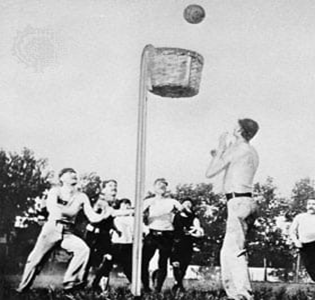
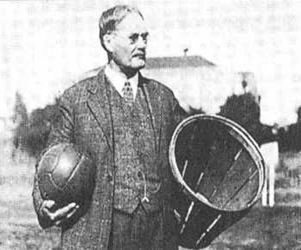
The game of basketball as it is known today was created by Dr. James Naismith in December 1891 in Springfield, Massachusetts, to condition young athletes during cold months. It consisted of peach baskets and a soccer style ball. He published 13 rules for the new game. He divided his class of eighteen into two teams of nine players each and set about to teach them the basics of his new game. The objective of the game was to throw the basketball into the fruit baskets nailed to the lower railing of the gym balcony. Every time a point was scored, the game was halted so the janitor could bring out a ladder and retrieve the ball. After a while, the bottoms of the fruit baskets were removed. The first public basketball game was played in Springfield, Massachusetts, on March 11, 1892.
Basic Rules
MAIN DIFFERENCES 3X3 VS 5V5
| RULE | 3X3 | 5V5 |
| HOOP | 1 | 2 |
| COURT | HALF | FULL |
| PLAYERS | 3-A-SIDE | 5-A-SIDE |
| BALL | 3X3 | 5V5 |
| PLAYING TIME | 10′ | 4 X 10′ |
| GAME OVER | 21 PTS | N/A |
| SHOT-CLOCK | 12″ | 24″ |
| FIELD GOALS | 1 OR 2 PTS | 2 OR 3 PTS |
| AFTER SCORING | NO BREAK | INBOUND |
Violations
The following violations result in a change of possession:
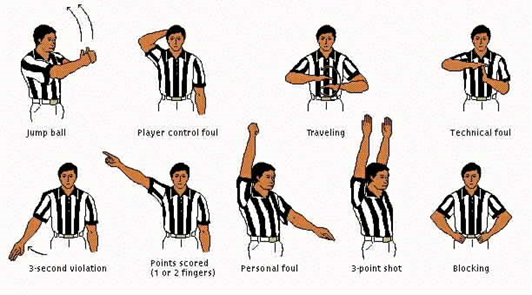
24-Second Violation – teams must attempt a shot within 24 seconds.
Three in the Key – An offensive or defensive player cannot remain in the lane (key) for more than three seconds at a time.
Double Dribble – A violation in which a player dribbles the ball, stops, then begins to dribble again.
Charging – A violation in which an offensive player runs into a stationary opponent.
Travelling – A violation in which a player takes too many steps without dribbling the basketball.
Eight-Second Violation – After a basket, the offensive team has eight seconds to get the ball over midcourt.
Lifting – A violation in which a player moves his hand under the ball and scoops it while dribbling.
Goal tending – When a defensive player interferes illegally with a shot on the rim or on a downward path to the hoop; the shot is assumed in and the offensive team receives the basket.
Mechanics
Fouls
Personal fouls occur when defenders make illegal contact with their opponents. If an opponent is in the act of shooting, free-throws are awarded. In high school and college, five personal fouls warrants an ejection, while professionals may commit six fouls before being disqualified. Technical fouls generally occur when a player behaves with unsportsmanlike conduct. In the NBA and college, the opposing team is awarded one free throw and possession of the ball. If a player draws two technical fouls, they will be ejected. Finally, two types of flagrant fouls exist. Type 1 is for either exceptional or excessive contact. Type 2 is when the contact is both exceptional and excessive. In both cases, the opposition receives two free throws and possession afterward. Disqualification occurs after two type-1 fouls or one type-2 foul in the NBA.
Scoring
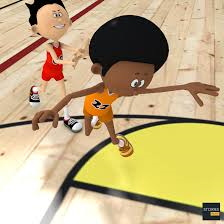
Each basket made in front of the three-point line is awarded two points. Baskets from behind this line are awarded three points. You also receive one point for each made free-throw — taken without interference from the free-throw line. If you are fouled in the act of shooting from the two-point range, you will receive two free-throws. If you were fouled when shooting beyond the three-point line, you will receive three free-throws. If you make the basket while being fouled simultaneously, that basket will count and you will receive one free-throw.
Dribbling Mechanics
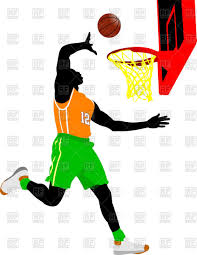
The proper mechanics for dribbling a basketball require that you keep the ball low and close to your body in order to make it as difficult as possible for the defender to steal the ball. Spread your fingers out wide and attempt to dribble with just your fingertips for greater control. Once you pick up your dribble, you are allowed two steps and are not allowed to dribble again. Taking more than two steps will result in a traveling violation, while dribbling again will result in a double dribble. The consequence of each offense is that the opposing team will be awarded possession.
Shooting Mechanics
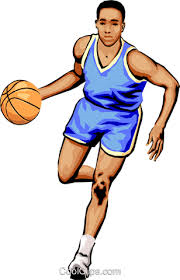
To properly shoot a basketball, have your feet shoulder-width apart and pointing directly toward the basket. Your shoulders should be squared to the basket as well. Your lead foot should be just in front of the other and in line with the basket. The elbow of your lead hand should be in line with this foot as you raise the ball to shoot. This will help assure that the ball will follow the direction of your foot and elbow, which should both be directly in line with the basket. Place your weak hand on the side of the ball during your shooting motion for greater stability prior to your release.
 Ballers